Latest News

Short-Term Technical Courses Gain Popularity Among Students
Coimbatore, April 2026: Short-term technical courses are gaining immense popularity among students seeking quick entry into the job market. Training institutes and online platforms are offering programs ranging from 3 to 6 months in fields such as web development, graphic design, video editing, cybersecurity, and digital marketing. These courses are designed to provide practical skills, real-world experience, and industry exposure, enabling students to become job-ready in a short period. Experts highlight that the growing preference for short-term courses reflects a shift in student mindset—from long-term academic programs to fast, skill-based learning pathways. Many students are also combining these courses with internships and freelancing opportunities, allowing them to earn while they learn. As the demand for skilled professionals continues to rise, short-term technical courses are expected to play a significant role in shaping India’s workforce.

EdTech Platforms Launch Job-Oriented Certification Programs
Hyderabad, April 2026: India’s EdTech sector is expanding rapidly, with platforms like upGrad and Coursera launching new job-oriented certification programs in collaboration with industry partners. These programs focus on high-demand skills such as cloud computing, DevOps, cybersecurity, UI/UX design, and digital marketing, offering learners practical training and placement support. One of the key features of these courses is their emphasis on hands-on projects, mentorship, and industry exposure. Students work on real-world scenarios, building portfolios that enhance their employability. Industry experts note that EdTech platforms are playing a crucial role in democratizing education, making high-quality learning accessible to a wider audience. With increasing demand for flexible and skill-based learning, EdTech is expected to remain a key driver of India’s technical education growth.

Hybrid Learning Model Becomes the New Standard in Technical Education
Mumbai, April 2026: The hybrid learning model—combining online and offline education—is rapidly becoming the preferred mode of learning in India’s technical education sector. Institutions such as University of Mumbai and Anna University have introduced blended learning programs that integrate online lectures, virtual labs, and in-person practical sessions. This model offers the flexibility of online learning while maintaining the effectiveness of hands-on training, making it ideal for technical courses. Students can access recorded lectures, participate in live sessions, and complete practical assignments in physical labs. Experts believe that hybrid learning addresses many challenges associated with traditional education, including limited access, rigid schedules, and lack of flexibility. It also enables institutions to reach a wider audience without compromising on quality. With advancements in technology and digital infrastructure, hybrid learning is expected to become a permanent feature of India’s education system.
New AI and Data Science Courses Introduced Across Universities
Bengaluru, April 2026: In response to growing demand for skilled professionals, several universities and technical institutes across India have launched new courses in Artificial Intelligence, Machine Learning, and Data Science. Leading institutions like Indian Institute of Technology Madras and Indian Institute of Science have expanded their course offerings to include specialized AI programs, advanced analytics, and deep learning modules. These programs are designed with a strong focus on practical training, real-world applications, and industry collaboration. Students are given opportunities to work on live projects, internships, and research initiatives in emerging technologies. Experts note that the demand for AI and data science professionals in India is expected to grow exponentially, with companies across sectors investing heavily in automation and digital transformation. Educational institutions are aligning their curriculum with industry requirements, ensuring that graduates are equipped with job-ready skills and technical expertise.

Online Degree Programs See Record Enrolment Across India
New Delhi, April 2026: Online education in India has witnessed unprecedented growth, with universities reporting record enrolments in online degree and certification programs for the 2025–26 academic cycle. Institutions such as Indira Gandhi National Open University and Amity University Online have seen a significant rise in applications, particularly in courses related to data science, artificial intelligence, cybersecurity, and business analytics. Education experts attribute this surge to increased awareness about flexible learning, affordability, and accessibility. Students from Tier-2 and Tier-3 cities are increasingly opting for online programs that allow them to learn while working or pursuing internships. Another major factor driving growth is industry acceptance. Employers are now recognizing online certifications and skill-based programs as valid credentials, especially when combined with practical experience and project work. The Ministry of Education has also expanded digital infrastructure and introduced new policies to support online and hybrid learning models, making education more inclusive and scalable. This trend is expected to continue, with online education playing a central role in India’s future learning ecosystem.
Technical Education Shifts Toward Skill-Based and Employment-Focused Models
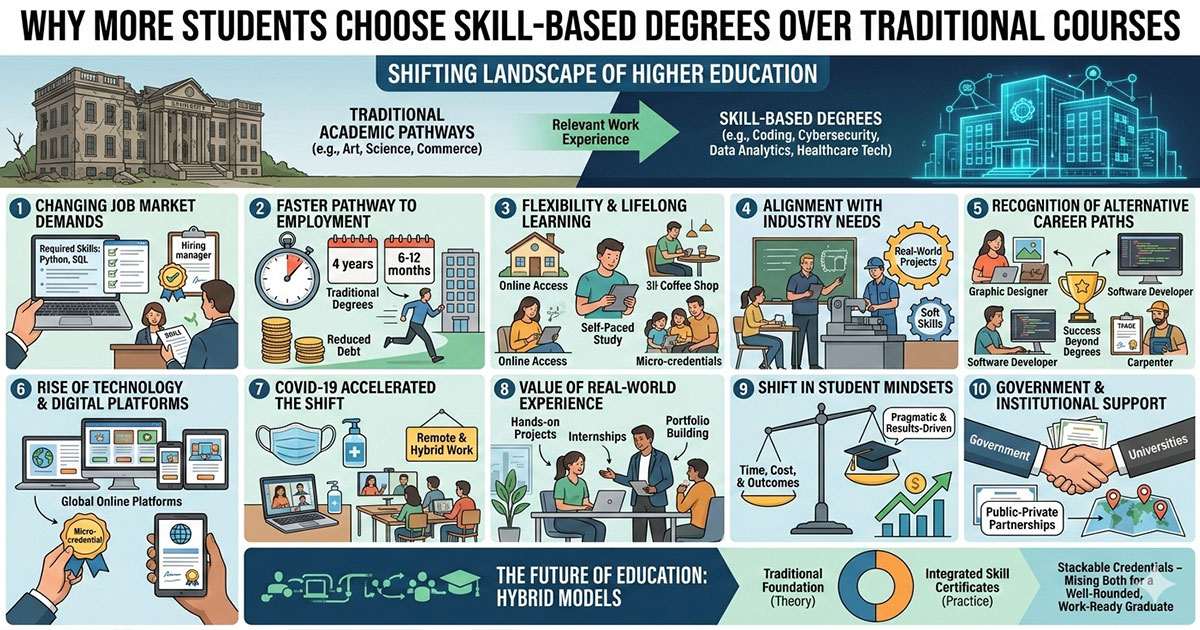
National, April 2026: India’s technical education landscape is undergoing a major transformation, driven by the need to improve employability and align education with industry demands. From AI integration in universities to industry partnerships and skill-based institutions, the focus is clearly shifting toward practical learning, real-world exposure, and job readiness. Government initiatives, recruitment drives, and curriculum reforms are collectively working toward reducing the gap between education and employment. Additionally, the rise of internship programs, bootcamps, and project-based learning models is helping students gain hands-on experience and industry exposure. Experts believe that this shift is essential for India to maintain its competitive edge in the global technology market. As industries evolve rapidly, the demand for professionals skilled in AI, cybersecurity, cloud computing, and DevOps continues to grow. Students who adapt to this changing landscape by focusing on skills, internships, and continuous learning will be better positioned to succeed in the future workforce.
Government Recruitment Drives Create Opportunities for Technical Graduates
Patna/Nashik, April 2026: In a major boost to employment opportunities, government bodies across India have announced large-scale recruitment drives targeting technically skilled candidates. The Bihar Technical Service Commission (BTSC) has released a notification for over 1,091 laboratory assistant positions across multiple technical disciplines, offering opportunities for candidates with science and technical backgrounds. Similarly, the Currency Note Press in Nashik has announced more than 500 vacancies under the Security Printing and Minting Corporation of India Limited (SPMCIL), providing career opportunities in technical and operational roles. These recruitment drives highlight the continued demand for technically skilled professionals in government sectors, particularly in areas related to engineering, laboratory sciences, and industrial operations. Experts suggest that such initiatives not only address employment needs but also reinforce the importance of technical education in nation-building and infrastructure development.

New-Age Tech Institutions Focus on Real-World Skills Over Traditional Degrees
New Delhi, April 2026: As concerns grow over the employability of engineering graduates, new-age institutions are emerging as strong alternatives to traditional technical education models. Recent insights indicate that while India produces over 1.6 million engineering graduates annually, a large percentage lack practical experience in real-world software development and AI applications. Institutions like Scaler School of Technology are focusing on hands-on learning, project-based training, and industry-relevant skills, enabling students to build real applications and work on production-level systems. Experts believe this shift represents a transformation in technical education—from degree-focused learning to skill-based, outcome-driven education. Students trained under such models are better equipped to handle real-world challenges and secure employment in competitive technology sectors.

Industry-Academia Collaboration Strengthens Skill-Based Technical Education
Chennai, April 2026: In a major boost to industry-integrated education, Vellore Institute of Technology (VIT) has signed a Memorandum of Understanding with Tata Motors to offer a specialized B.Tech program in Manufacturing Engineering. The program is uniquely designed for employees of Tata Motors’ Ranipet plant, allowing them to pursue higher education while continuing their professional roles. This initiative reflects a growing trend of work-integrated learning models in India’s technical education ecosystem. Education experts note that such collaborations are critical in bridging the gap between academic learning and industrial requirements. By combining classroom knowledge with real-world experience, students gain practical exposure, technical expertise, and job-ready skills. The partnership also highlights the increasing role of corporates in shaping technical education, ensuring that curricula remain aligned with industry needs and technological advancements.
Universities Introduce AI Across All Courses to Build Future-Ready Graduates
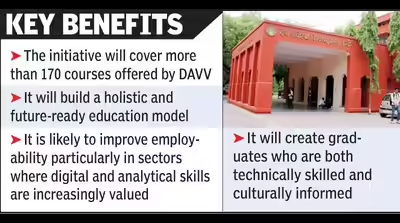
Indore, April 2026: In a significant shift towards future-ready education, Devi Ahilya Vishwavidyalaya (DAVV) has announced the integration of Artificial Intelligence (AI) into all undergraduate and postgraduate courses starting from the 2026–27 academic session. The initiative will cover over 170 courses across disciplines, including engineering, commerce, management, and humanities. The move reflects a growing trend in India’s technical education system, where AI is no longer limited to specialized programs but is becoming a core interdisciplinary skill. In addition to AI, the university will also incorporate Indian Knowledge Systems (IKS), aiming to blend modern technological education with traditional knowledge frameworks. Faculty members will undergo training to effectively deliver the updated curriculum without increasing academic burden. Experts believe this model could redefine technical education by ensuring that every graduate possesses basic AI literacy, data understanding, and digital problem-solving skills, making them more employable in a technology-driven economy.